Tampilkan postingan dengan label Omega. Tampilkan semua postingan

Jumat, 26 Oktober 2012

The Wristwatch Space Race

Mercury 7
While USA and Russia were racing to get the first man in space, there was another race in place.

The Wristwatch Space Race.

Buzz Aldrin in the Apollo 11 Mission to the Moon
Think for a moment what watch brand comes to  mind when envisioning the first watch in space.
Probably Omega.  Omega has the same effect when one thinks of the Olympics. 


You may draw a mental reference to the highly publicized image of an Omega Speedmaster around the wrist of Buzz Aldrin sitting in his lunar module during NASA's Apollo 11 mission. ( Link to Space Exploration on Omega's Website)

Before you think I am disregarding Omega's influence in space let me begin by saying that without a doubt the Omega Speedmaster was the professional moon watch chosen by NASA for its ability to withstand the adverse conditions in space.  It was the only watch NASA approved for EVA.

For more info click here on an excellent article,
 " The Moon Watch: A History of the Omega Speedmaster Professional"  by Alan A. Nelson (M.D.) and published in the February 1993 NAWCC Bulletin.

Omega was the first watch worn on the moon, but there is a watch movement still on the moon.  It is no longer working of course, but it was meant to continue humming for a year after the Apollo 11 Mission.  I use the term "humming" not "ticking", because the watch movement placed on the Sea of Tranquility was a Bulova Accutron within a NASA lunar instrument. The Bulova Accutron did not behave as well on the instrument panel of the lunar module and so Neil Armsrtong left his Omega Seamaster on board as a backup.
Neil Armstrong and Buzz Aldrin stepped onto the moon on, July 21st, 1969 and the   Omega Speedmaster only became the official NASA watch  as of March 1st, 1965 “Flight Qualified for all Manned Space Missions”, but their was quite a bit of space travel beforehand, particularly the Mercury Missions and the Soviet Vostok Programme. .

Bulova Accutron Movement in Space

I suppose you can say the Bulova Accutrons were the first clocks in space.  An Accutron was installed onto the instrument panel of the Vanguard I. It was the very first Electronic Watch, and thus was quite prevalent on a Satellite. I found no mention of any clocks on the Sputniks or Explorers aside from beep intervals. (I would love any additional information on this.)

Mercury Seven Scott Carpenter Wearing an Accutron
In the late 1950's, before either USA or Russia sent a man to space, the very new NASA asked Bulova to incorporate Accutron technology into their space equipment. NASA was established on July 29th, 1958 with President  Eisenhower the National Aeronautics and Space Act in response to the Sputnik crisis.
 At that time the CEO of Bulova was Omar Bradley, a five star highly decorated retired general who served in both World War II and the Korean War.  Omar Bradley was a former classmate of President Eisenhower.
 For this new accelerated era in space exploration efforts, new advanced technology was deemed necessary. Since Accutron had come up with the most precise way of timekeeping to date, Accutron was chosen as the timekeepers on the instrument panel of space crafts.

Accutron was the world's first electronic watch, later obviated by the Quartz Watch.  1977 was the final year for Accutron 214's. Accutron's are highly collectable.

The watch boasted an accuracy of two seconds a day or one minute a month.  The Accutron 214 did not tick, but hum.  Its basic principal was that of a tuning fork, which was electrically excited and vibrated at 360 Hz. This type of accuracy provided by the Accutron was critical in space flight.  The Accutron Clocks were installed as Space Craft  Panel clocks.

Click here for more info on Accutron Watches

Accutron Movement 214
Benton Harbor News Palladium - August 12 1969
Max Hetzel:  Max Hetzel, an engineer born in Basel Switzerland, and employed by Bulova as a development engineer between the years of 1950-1959 ,developed the Accutron. 20 patents later, in 1959, he became chief of R & D. Although Max Hetzel was born in Switzerland, he was not into watchmaking per se, but rather into electronics.  He started young building radios at age 12. He felt mechanical watches were outdated and new more technologically advanced timekeepers were more prevalent for the electronic era.

His ideas did not sit very well with the Swiss - a country were mechanical watch making is a huge industry.
He moved to the USA and become an Ameican Citizen. \His success at Bulova resulted in NASA asking Bulova to incorporate all its new Accutron technology in its NASA space equipment and in 1967 his Accutrons were the only clocks on board Air Force One.

In 1969, Max Hetzel became the CEO of OMEGA's subsidiary Elresor SA.  He wanted  to develop a better movement than his own previous Accutron patent. The result of his efforts was the Swissonic, which  ,as a result of patent conflicts with Accutron, was never marketed.  Funny thin was  Max Hetzel ,the creator of Accutron, was actually working for Omega on its Megasonic Program when his Accutron movement  was placed on the moon. 


Yuri Gagarin - Vostok 1 - Sturmanskie Wrist Watch

The precision of Accutron's and the resilience of Omega were excellent aspects of space worthiness, but both brands were not the first in space.

Sturmanskie
The first watch in space was neither an Omega or Accutron, but rather a Russian made Sturmanskie Timepiece.  On the 12th of April 1961,on board the Vostok 1,  Soviet cosmonaut Yuri Gagarin was the first man to enter space and the first man to orbit the earth.  Strapped around his wrist was a Russian Made Sturmanskie Timepiece.

 The Sturmanskie's 17 jewel movement was housed within a shock absorbent chrome plated two piece case measuring 33mm in diameter and 12mm in height.  This particular watch had a stainless steel screw in case back instead of a stainless steel snap on case back as with the earlier Sturmanskie models. Yuri Gagarin's model was highly finished with Geneva striping.   In addition the implementation of gaskets increased water resistance. The watch functioned perfectly in conditions of zero gravity.
 The watch was based on a French design, the Lip R26.  To manufacture the Sturmanskie, the 1st Moscow Watch Factory originally purchased the machinery from the French.  Due to the watches precision, resilience and reliability in adverse conditions, it was a formality to provide all new graduates from the Orenberg Flight School with a Sturmanskie.

Apollo 14
Alan Shepard - 1st Mercury Mission MR-3 Freedom 7 - No Wristwatch on Record

  On 5th of May 1961, the first Mercury Mission, the USA sent Alan Shepard into space as a pilot of the Freedom 7. He became the first American in Space.  Alan Shepard chose not to wear a watch on that mission. He did wear an Omega Speedmaster ,as did Stuart Roosa and Edgar Mitchell, almost ten years later  on his Apollo 14 Mission to the moon on February 5, 1972. In the Apollo 14 mission, the Omega Speedmasters were worn on the outside of the spacesuit on a specialized velcro NASA black nylon strap as per the specifications of NASA. It has been speculated that Ed Mitchel - who spent 9 hours and 17 minutes working on the surface of the moon, was wearing a  Rolex Pepsi GMT Master on his right wrist and his Omega Speedmaster on his left.  So it could be that a Rolex GMT Master accompanied the Omega Speedmaster on the longest moon walk.

Gus Grissom - MR-4 Liberty Bell 7- No Wristwatch on Record:

On July 21st, 1961 Virgil "Gus" Grissom piloted the MR-4 spacecraft Liberty Bell 7 for a suborbital flight lasting 15 minutes and 37 seconds becoming  the Second American in Space. Gus Grissom returned to earth with a splash and due to the premature opening of the Liberty Bell 7's hatch, the spacecraft took on water and was sinking fast.  Gus Grissom managed to exit the space craft.  After failed efforts by the rescue helicopter to lift The Liberty Bell 7 it sunk  to a depth of 4.6 km. It was later recovered on July 20th,  1999. Besides for the pressure valve strapped to his wrist, he wore no watch on his wrist.  The Mercury Spacesuits had mirrors on the inside of both wrists and on the chest, for instrument panel read out. Gus liked watches though and owned a 24-hour Le-Coultre stainless steel military anti magnetic, shockproof, water resistant wristwatch baring a black 24 hour face, which he wore on special occasions down here on earth.
On March 23rd, 1965 Gus Grissom became the first astronaut to fly into space twice as the Command Pilot of Gemini 3, which he called Molly Brown. (From the Musical "The Unsinkable Molly Brown).  On this mission he took with him two engraved wristwatches for his sons Scott and Mark. (I could not find any info on the brand of these two watches).  Gus Grissom tragically  lost his life on January 27, 1967 during an Apollo 1 simulation ahead of the scheduled February 21st launch date.
Tag Heuer Carrera SpaceX 1887 Chronograph circa 2012

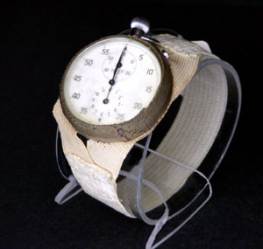
John Glenn MA-6  Friendship 7 -  Tag Heuer StopWatch on Elastic Band:

Tag Heuer also has its moments of space fame and joined in the race pretty early on. On February 20th, 1962, John Glenn became the first American to orbit the earth and the third American up in space on the Mercury-Atlas 6 mission. Around his wrist was a Tag Heuer Stop Watch. With his statement, "The Clock is Running", he orbited the earth three times.  The flight took 4 hours, 55 minutes and 23 seconds.  The Tag Heuer was fashioned with elastic bands to fit over the space suit.   NASA chose Tag Heuer as the watch of chose able to withstand the intense G-forces of lift off.
To celebrate Tag Heuer's 50th anniversary  the first watch company in space, Tag Heuer unveiled the 43mm Tag Heuer Carrera SpaceX 1887 Chronograph, which will is available for $5,800 USD in a limited edition of 2012 pieces. (above image)


Breitling Navitimer Cosmonaute - Left Wrist

Scott Carpenter MA-7 Aurora 7 - Breitling Navitimer Cosmonaut
 
On May 24th, 1962 Breitling joined the Wristwatch Space Race becoming the first wristwatch chronograph to enter space.   Scott carpenter (who was photographed in a French magazine wearing an Accutron), the second American to orbit the earth and the 4th person in space,  opted for a Breitling while orbiting the earth in his Aurora 7 capsule no less than three times. In 1961 Scott Carpenter actually approached Breitling to make him a watch with a 24 hour dial - since a 12 hour dial will be useless in space where there is no night and day. A Breitling 24-hour Navitimer Cosmonaute (astronaut in French) was delivered three days before he was scheduled to leave on his Mercury-Atlas 7 mission. To celebrate 50 years of the Mercury-Atlas 7 mission, earlier this year  Breitling unveiled a manual winding  in-house  Navitimer Cosmonaute limited to 1962 pieces.  In recognition of Scott Carpenter's wristwatch - which incidentally has never been located since the famed mission - this certified chronometer chronograph sports a 24 hour display, Fahrenheit / Celsius degree conversion scale, bi-directional rotating bezel,  handy circular slide rule and a 70 hour power reserve. Engraved on the case back is the Insignia of the Aurora 7.


Towards the end of 1962, a telling sign for the Wristwatch Space Race was Bulova's highly publicized modified wristwatch strap for the X-15 pilots. All the newspaper clips from that time specifically stated these straps were for Bulova's electronic wristwatches. 
Since NASA only made the Omega Speedmaster  “Flight Qualified for all Manned Space Missions” on the 1st of March 1965, in 1962 the wristwatch space race was still on.


Wally Schirra sporting an Omega Speedmaster


Wally Schirra - MA-8 Sigma 7 - Omega Speedmaster: 

On  October 3, 1962 Wally Schirra ,one of the original Mercury Seven forged the way for Omega up in Space.  Wally Schirra, the fifth American in Space wore an Omega Speedmaster piloting the Mercury-Atlas 8 on a 6 orbit mission lasting 9 hours, 13 seconds and 11 seconds. To commemorate the 50th anniversary of this historical event Omega this month unveiled at BaselWorld 2012 a “First Omega in Space” Speedmaster 1962. This Omega Speedmaster is powered by a Caliber 1861, which is based on a manual winding  Lemania 1871 Chronograph movement. (Automatics do not work where there is no gravity).  Engraved on the case back is Omega's original seahorse logo and the words, “THE FIRST OMEGA IN SPACE” and “OCTOBER 3, 1962”. This watch is not a limited edition and will appear in stores around October 2012. Wally Schirra passed away on May 3rd, 2007.


 "So I used my wrist watch for time," Gordon Cooper Faith 7

Accutron Astronaut seen on Gordon Cooper's Wrist Prior to Faith  7
Gordon Cooper - MA-9 Faith 7 -  Omega Chronograph & Bulova Accutron Astronaut: 

The final Mercury Mission on May 15th, 1963,  sent Gordon Cooper into space for 34 hours,19 minutes and 49 seconds  orbiting the earth 22 times.  He piloted the Mercury-Atlas 9 or Faith 7 and slept some.  This particular mission emphasized the need for instruments not reliant on the instrument panel.  The X-1 pilots like Chuck Yaeger of Rolex wristwatch fame and the first pilot to break the speed of sound, joked that the Mercury Astronauts had no need to "pilot" the spacecraft, as the crafts were designed for fully automatic control.  He described the Mercury 7 as "Spam in a Can".  He was proven quite wrong ,though,when due to technical problems Gordon Coopers Space capsule lost power. The situation became dicey when CO2 levels and temperature levels rose. Gordon Cooper mastered the controls and using his celestial knowledge was able to calculate the correct pitch for re-entry into the earths atmosphere. Making even a slight miscalculation would have been grave.  A sharp angle into the atmosphere would result in destructive g-forces, a too shallow trajectory would cause the tiny capsule to bounce off the atmosphere and head back into space.  Amazingly Cooper used the capsule window to draw lines determining the precise orientation before firing the reentry rockets.
So I used my wrist watch for time," he later recalled, "my eyeballs out the window for altitude. Then I fired my retrorockets at the right time and landed right by the carrier." (via Wikipedia)

Gordon Cooper's Bulova Accutron Astronaut
So which wrist watch did he use?   In actual fact Gordon Cooper was wearing two wristwatches: An Omega Chronograph and a Bulova Accutron.  As to which watch he used for reentry calculation - well the Omega Speedmaster enthusiasts will say an Omega Speedmaster and the Bulova Accutron collectors will say the Accutron. Although the majority are on the side of the Omega Speedmaster - Most of the consensus rests on the fact that Gordon Cooper brought the Bulova Accutron along on Faith 7 to double check the timing of the Omega Speedmaster. Gordon Cooper used the Omega Speedmaster to monitor the firing sequence of the retro rockets for atmospheric reentry.

 Upon returning, NASA presented Gordon Cooper with a Timex Wristwatch as a welcome back gift.  This watch cropped up at a Heritage Auction in 2009 together with a letter written by Gordon Cooper himself, acknowledging the authenticity of the watch.

With the return of Gordon Cooper in the Faith 7 the Mercury Era had ended and NASA had their sites set on the Gemini and Apollo Missions.  Every component and aspect of the Mercury Missions were analyzed by a crew of newly appointed NASA engineers.  New equipment and instruments including wristwatches worn by the astronauts  were chosen for rigorous testing.

Gemini & Apollo Missions - Omega Speedmaster Professional: 

The astronauts approached Deke Slayton, Operations Director at NASA and one of the Original Mercury 7,  to find and provide an official wristwatch for training and in-flight use. 
Deke Slayton took this request very seriously and sent an internal memo to the engineers:

Ed Mitchell Omega Speedmaster Apollo 14
A requirement exists for a highly durable and accurate chronograph to be used by Gemini and Apollo flight crews as an essential adjunct, or as a backup for spacecraft timing devices and for accomplishing time critical operations and experimental tests. In order to select a chronograph which best meets our overall requirements, it is necessary to accomplish a comparative evaluation of the better quality "off the shelf" chronographs under realistic operational conditions. The evaluation will take place during such flight crew training programs as the Gemini Mission Simulators, during spacecraft and other flight equipment testing in the altitude chambers, egress and recovery exercises, planetarium reviews, and during the first two manned Gemini flights. The evaluation will be of the basic "off the shelf" items; however, an analysis will also be made of any additional features and/or modifications that may be required.
It is highly desirable that we commence with this evaluation at an early date so that a standard flight crew chronograph can be obtained prior to the longer duration Gemini flights and the Apollo flights. The evaluation items should be available during the preflight training for the first two manned Gemini flight crews, which are now in progress. On this basis, quotations from various chronograph manufacturers meeting the specifications as listed in analogue 1, Statement of Specifications, should be reviewed by this organization by October 21, 1964. Immediately subsequent to this date, it is our intent to purchase locally at least one of each brand that meets, or very nearly meets, these specifications. Off the shelf chronographs which very nearly meet the specifications may be considered if they, in other regards, surpass the overall specifications. The manufacturer in this case may choose to reply to the request for quotations, however, NASA-MSC will make the determination as to whether or not the chronograph will be subsequently evaluated. It is estimated that a total of twelve chronographs are required for evaluation purposes.

  James Ragan - engineer - suggested a list of manufacturers: .Elgin, Benrus,Hamilton, Mido, Lucien Piccard
OMEGA, Bulova, Rolex, Longines, Gruen   Four Brands responded, providing NASA with two watches each for testing.

The testing included:

  "The tests which ensued were designed literally to test the watches to destruction. The watches were subjected to temperatures ranging from 71° to 93° centigrade over a two day period, after which they were frozen to -18° centigrade. They were placed in a vacuumed chamber heated to 93° centigrade, and then subjected to a test where they were heated to 70° centigrade and then immediately frozen to -18° centigrade – not once but fifteen times in rapid succession! When this had been completed, it was time to subject the watches to 40 g shocks in six different directions, then submit them to high and low pressures, an atmosphere of 93% humidity, a highly corrosive 100% oxygen environment,  noise to 130 decibels and finally vibrated with average accelerations of 8.8 g. In the end only one watch had survived: the Speedmaster. Interestingly, after each test the watch would settle to an average rate which was largely within the NASA imposed limits of five seconds per day during normal use."
Source: Official Omega Website

Omega did not even know that their Speedmaster was the one that qualified for man missions to space until the release of the Gemini IV mission photographs. After finding out, Omega renamed the Omega Speedmaster to Omega Speedmaster Professional.  The name stands until today.

American Made Bulova was not impressed - how could NASA choose the Swiss Brand Omega over the American Brand Bulova. Apparently there was an investigation and the Omega Speedmaster was found to  display the most integrity in space. However, I cannot deny there is much internet and forum murmurings on how Omega became the Official NASA watch, but until sound proof is found - rumors will be rumors.


It may seem strange that Omega did not know  their Omega Speedmaster had become the chosen timepiece for the NASA astronauts- but judging from a snip it  (left) from the Leader Times Kittanning, PA - May 20th, 1963 - "American Astronauts are prohibited from endorsing commercial products"

From the article however its apparent the Russians had a different take. Russian Astronaut, Gherman Titov" appeared in a Magazine endorsing a Russian-made wristwatch (probably a Sturmanskie). Gherman Titov was a highly decorated astronaut who on August 6th, 1961 who on Vostok 2 became the second person to orbit the earth and the fourth person up in space and the first to Orbit the earth multiple times (17).
The Soviets took advertisements to a new level whereby hundreds of products endorsed the Soviet Space program.

On June 16th, 1963 - on board the Vostok 6, the first women in space,  Valentina Tereshkova wore a Sturmanskie timepiece.

Strela Chronograph
Alexey Arkhipovich Leonov - Voskhod 2 - Strela 

The watch worn during the first spacewalk performed on March 18th, 1965 by Russian cosmonaut Alexey Arkhipovich Leonov during the Voskhod-2 was a Strela. He was in space for 12 minutes and 9 seconds. The Strela was actually based on the Venus Caliber 175 movement designed by horological genius Andre Frey of  Fabrique d'Ebauches VĂ©nus S.A (now Minerva).  The Strela had a Column Wheel Chronograph and two sub dials: A 45 minute totalizer and a constant seconds sub dial. In addition a central chronograph  hand tracked seconds. The case material was a humble chrome plated base metal.  These watches were only available to the Soviet Air Force.The Strela was often said to be the Russian version of the Omega Speedmaster.

In space exploration years that followed, cosmonauts wore a variety of different brands since Russia was not as stringent as NASA in terms of  watch regulations. Often cosmonauts were spotted with, Sturmanskie,  Sekonda and OKEAH.  Other movements like the Poljot 3133 based on the Valjoux 7734-Russians purchased the machinery from the Swiss in 1974, replaced the Strela. For more info Click here for an intriguing component by component detail of the Pojot 3133 and Valjoux 7734 similarities and differences.  
After Quartz erupted on stage Digital watches were a common site around the wrists of cosmonauts.

Gemini IV Mission Photographs Shows Newly Issued Omega Speedmaster

On June 3rd, 1965  Ed White wore an Omega Speedmaster 105.003 secured with velcro and a long nylon strap to the outside of the left-side sleeve of his G4C spacesuit, during the first American Space Walk.

Click here for a well documented time-line of Omega in the Gemini and Apollo Missions.

Although the Omega Speedmasters were the Official Watch Worn by Astronauts, they were allowed to bring along a second watch.  Jack Swigert wore a Pepsi Rolex GMT on the Apollo 13 mission - Click here for an in depth look at Rolex Watches in Space. ; Timex became a favorite among astronauts later on; 
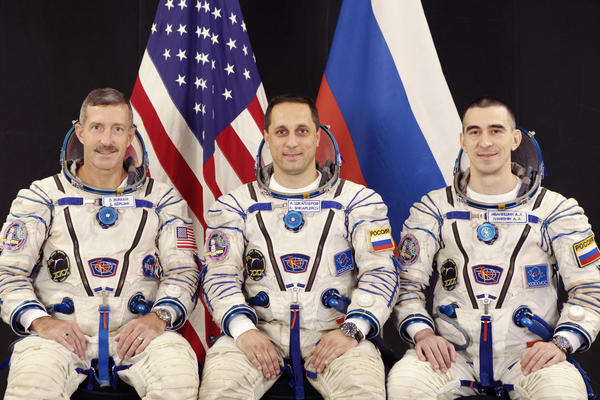
Russian Cosmonauts Sporting Fortis Timepieces

In 1994, after two years of intense testing at the Yuri Gagarin Russian State Scientific-Research Test Center of Cosmonauts Training in Star City, Fortis watches have become the official timepiece issued to cosmonauts.  The first crew to embark on a mission with a Fortis on their wrist was the EUROMIR crew.  Now all Russian cosmonauts at the Gagarin Center are presented with a Fortis.

 NASA has increased their list of acceptable watches to include the following: 


  • Omega Speedmaster Professional 3570.50.00
  • Omega Speedmaster Professional X-33
  • Casio G-Shock DW-5600C
  • Casio G-Shock DW-5600E
  • Casio G-Shock DW-5900
  • Casio G-Shock DW-6900
  • Timex IRONMAN Triathlon Data Link  
(This list is from 2008 - there may be some model changes)
 
The latest watch in space to make space history:


'

Felix Baumgartner - Stratosphere Free Fall - Zenith Stratos Flyback Striking 10th: 

On October 14th, 2012, Zenith Ambassador,  Felix Baumgartner became the first human to break the sound barrier during an 833mph free fall of 128,100 feet from the stratosphere, strapped to his wrist ,outside his spacesuit, was a Zenith Stratos Flyback Striking 10th. The Zenith Stratos was specially designed to withstand the immense velocity during the fall. The 30 mm specially reinforced stainless steel case housing an exceptional 326-component El Primero Automatic movement as well as the Striking 10 and Flyback Function.This watch is the first watch to cross the sound barrier in a near space environment.
Watch Felix


Jumat, 17 Agustus 2012

The Olympics Omega Lost to Longines.

It is a great honor to be an Olympic Timekeeper - an honor which has been an unbroken chain of timekeeping triumphs for Omega since Los Angeles 1932. Almost unbroken that is... For whatever reason Omega lost its right to time the ill-fated Munich 1972 games.
In a recent exclusive interview with Master of Sports-timing ,since 1969, Omega's Peter HĂĽrzeler and Swimming World, Peter explained:

"In those years, we were two big watch groups- OMEGA and Longines. We were timing competitions in our respective names, and were able to collaborate for major events, but, we were 30kms away doing the same thing. In 1972, after we lost (the right to time-sic) the Olympic Games in Munich, Swiss Timing was founded to be the leader in sports timekeeping. OMEGA returned as Official Olympic Timekeeper in 1976" 

So Longines got the right to time the  Munich 1972 Olympic games, a bitter sweet one-time honor clouded by the Munich Massacre in which 11 Israeli athletes and trainers were surprised in their sleep and captured by a Palestinian Terrorist Organization - Black September. The 11 Israelis and trainers were all murdered.

Senin, 23 Juli 2012

Omega Official Olympic Timekeeper Since LA 1932

Olympic Pocket Watch 1932 Limited Edition
Since the LA 1932 Olympics Omega has been keeping Olympic's time. Things have changed over the last 80 years from 30 stopwatches  in 1932 to the Quantum Timer of London Olympics 2012.  The Quantum Timer, its name almost suggests a leap into the past or future, is more efficient than its predecessors of past Olympics.  With this device Omega can integrate main and backup units into a single device eliminating errors and speeding up final results.  Omega has made incredible timekeeping innovations in swimming, and this year "The Open Water Gates" utilizing high definition cameras and transponder technology will make the swimming events increasingly accessible to the media and public.
Another great feature first introduced in the 1948 London Olympics is the athletics starting block which measures the runner's reaction time by force against the block not the visible movement.

Though the passage has time has improved Omega's timekeeping abilities by Quantum leaps, Omega honors its first Olympic timekeeping experience with a Limited Edition commemorative Olympic 1932 Pocket Watch. The chronograph pocket is a certified chronometer having passed the rigorous testing performed by the COSC. The manual winding chronograph movement is powered by a Caliber Omega 3889.  This high performance movement has an integrated rattrapante chronograph mechanism controlled by a double column wheel.  The movement is Rhodium-plated sporting circular graining and Geneva waves. (ref; Omega)
The pocket watch is capable of a 32 hour power reserve.  Beneath a domed anti-reflective, scratch resistant sapphire crystal, a snowy white dial lends a stark contrast to the bold black Arabic Numerals and striking red Omega insignia. Exquisite blued steel hands  A small seconds sub dial lays claim to the 6 'o'clock position, while a chronograph counter presides upon the 12 'o'clock.  The Limited Edition Olympic Pocket Watch 1932 is available in white gold, red gold or yellow gold and each flaunts the Omega logo fashioned from gold above its crown.


Rabu, 04 April 2012

Omega's Olympic London 2012 Collection

The Amirillo Sunday News, July 25th, 1948
The Olympics will be back in London come summer 2012 and   Omega will be timing the games for the 25th year.  To commemorate Omega's 80th year as the Olympic Games official Timekeeper, Omega launched an Olympic Collection London 2012.

Three versions of the   Olympic London 2012 Seamaster co-axial chronometer watches are available.

The most sporty looking of the three is a Seamaster chronograph timepiece with a steel case and bracelet surrounding a blue dial priced at  $7,600. The Olympic Logo is emblazoned in steel on the case back.

The second chronograph timepiece is more classical in design. A red gold case and blue dial and strap - currently the most trendiest  color combination. This Seamaster features a transparent case-back revealing its movement.


The third watch is an OMEGA Seamaster 1948 Co-Axial “London 2012″ in steel with a solid yellow gold case back sporting the logo of the  London Olympics 2012.  This watch is priced at $6,800.  This watch is limited to 1948 pieces, representing the last year the Olympics were in London and the  year the Omega Seamaster was launched. The watch is powered by a highly efficient Automatic Caliber 2202, sporting a Co-Axial Escapement for optimum precision and durability.  A silver dial with an hour minute and small seconds sub-dial at the 6 'o'clock is the most formal watch of the three.  A black leather strap is sealed by a matching polished steel buckle.  The Omega Seamaster 1948 is water resistant to 120 meters and is capable of a 48 hour power reserve.


At the heart of the first two watches is an Omega 3313 self-winding chronograph movement with a highly efficient column wheel mechanism and Co-axial Escapement ensuring maximum precision. The watches harbor a free sprung balance and display a date,hour,minute and continuous small seconds hand.  A central chronograph hand ensures reliable timing of the races.

Both the Chronograph watches are equipped with a crown which screws into the tube of the case and  locks.  This feature maximizes the water resistancy of the watch to 500 meters.


Omega has opted to utilize an outside source to ensure maximum performance, efficiency, precision and reliability ,even in adverse conditions, by having the movement tested by the ContrĂ´le Officiel Suisse des Chronomètres or Official Swiss Chronometer Testing Institute. (COSC).  The movement undergoes a battery of rigorous tests in order to achieve the status of chronometer.  After Rolex, Omega is one of the companies which submit the largest amounts of movements to be tested by the COSC.  As an added precaution of authenticity, a serial number ,officially certifying the movement as a chronometer, is engraved into the movement.

The dial of the watches are protected by a domed scratch resistant Sapphire crystal treated with an anti-reflective coating enabling maximum read out against the glare of the sun.

 Omega is the Official Timekeepers at the Olympic Games and has been since Los Angeles 1932 Olympic Games and the 1936 Olympic Winter Games in Garmisch-Partenkirchen, Germany -  when a single Omega technician came to the games hauling 27 stopwatches. In the intervening years , from then till now, Omega's expertise in Olympic timekeeping has increased dramatically.
In this years Olympics all eyes will be on 26 year old Omega Ambassador Swimmer Legend Micheal Phelps winner of no less than 14 gold medals and 2 bronze with Omega timing his progression stroke by stroke.

As far as efficiency, durability and precision goes, these watches are the complete package.  All three timepieces attract  different tastes for different occasions. 

Purchasing a watch commemorating an event adds a collectible quality to the timepiece especially if  manufactured in limited editions.

Rabu, 05 Oktober 2011

A Look at Omega's Silicon Balance spring

My fascination with watches extends far beyond the aesthetic "wow" factor, but penetrates deep into the bowels of the movement.  Every component is an entire system unto itself, crafted to its own unique perfection, receiving feedback and giving feedback in a complex transfer and stabilization of energy.  A timepiece is better than the sum of its parts providing extreme, efficiency, competency and accuracy in time display; however, as the saying goes: " A chain is only as strong as its weakest link."
A watch with a weakness in any  component will confound the movement, thus the quest for optimum materials for watch components  is one of the branches of research at the forefront of watch innovations. 
Omega has used its technology to develop a unique material for its balance spring: Silicon.
  A balance spring is one of the most important components for the accuracy of a time piece.  The Balance Spring , for example the  flat spiral or Bregeuet over-coil (extremely visible and elevated in MB&F Legacy Machine No.1 Watch-see inset),  is attached to the balance wheel and controls the rate at which the wheels turn, effecting the rate at which the hands on the dial turn. On the balance spring, a regulator adjusts and regulates the speed maintaining time tracking precision.
  The Balance Spring is extremely sensitive to shocks (fast jagged motions and abrupt stops-such as during a game of tennis or if inadvertently dropped) as well as to magnetic fields.  If the balance spring is exposed to these factors, it may sustain damage or displacement causing the efficiency of the timepiece to dramatically decrease.
Since the balance spring is critical for precision, much attention has focused on increasing the resilience of this component.
Omega has increased the Balance Spring's shock absorbency and stability as well as eradicating the effects of any magnetic field by crafting the Balance Spring in silicon.   See video below


Rabu, 23 Desember 2009

Omega's Museum Collection's Latest Edition.

Omega is releasing modern versions of watches from its past. The latest of which is the Omega Milestone 1941 (above), the ninth in Omega's Museum Collection. Based on the original CK 2080 (inset) which was released in 1938, the newer version has a busier face which includes a tachymeter ( to compute speed based on travel time or measure distance based on speed), telemeter just below the bezel (to measure the distance of a phenomenon which is both visible and audible i.e thunder and lightening), 30 minute chronograph and the time. Although the face is quite busy, the hour ring is immediately discernible with aid of the large bold 12, 6 and hour indicators and hands coated in SuperLumiNova. The minute track is between the telemeter and the tachymeter. The two sub-dials at the 3 'o' clock and 9 'o' clock displays a the 30 minute chronograph and seconds counter respectively. The inner concentric circles are related to the tachymeter measurements.
At face value, the Omega Milestone 1941 or Number 9 as it sometimes is reffered to is quite similiar, both have a black face, white dial markings and really cool lugs; however beneath the surface the difference is quite marked. The CK 2080's newer counterpart sports a modern Omega Caliber 3203 Co-Axial manually wound movement with a column wheel for the chronograph complication. The Omega CK 2080 from 1938 was a stainless steel watch quite popular among the high ranking military officers. The Omega Milestone 1941 is crafted from 18k white gold with a limited edition of only 1941 pieces meant for collectors and watch enthusiasts.
Omega's vision in presenting the Omega's Museum Collection is to combine its long standing tradition of fine watchmaking and its dedication to cutting edge technology.

Kamis, 20 Agustus 2009

Wandering through airport terminals with Watches on my Mind.


Bvlgari BB23GLD Bvlgari-Bvlgari Black Dial Leather Women's Watch

The current time on my watch is 4:30pm. The current time in Spain - last stop before I hit the shores of the USA. My journey was marked with seeing close relatives for the first time in 15 years, and perusing watch boutiques at airport Duty- Free counters.
Cartier has a strong airport presence with Cartier Roadster Watches, Tanks, Pashas and the Santos Collections. Breitling, Omega, Bvlgari and Rolex are also quite prevalent. Swatch watches take up center stage and its position in the airport terminals are framed by towering pillers displaying the latest swatch models. Swatch Watches saved the watch industry and I have the utmost regard for them.

Cartier  Roadster Silver Dial White Gold and Leather Women's Watch 

As I was peering at the Breitling watches, I asked a lovely lady behind a watch counter if she had ever sold the Breitling Emergency watch at the airport. She looked at me with utter disdain.
"No!" she said shaking her head, "What if someone presses the emergency button in here, it would be mayham."
A sudden image of an emergency distress call specifically designed for civil aviation confusing air traffic control entered my mind. She had a point.
The Breitling Emergency broadcasts on the 151.5 MHz distress frequency. However, as of February 2009, the Cospas-Sarsat which operates a satellite constellation that relays distress alerts to search and rescue authorities through a worldwide ground communications network, stopped monitoring the 121.5/243 Mhz frequency's. Breitling has no plans to change the 121.5 MHz frequencies on its Breitling Emergencies as aviation will still monitor the 121.5 MHz frequency especially during a rescue attempt.
After perusing the terminals with my over sized carry on luggage banging against my legs, I sat down and decided to read a perfectly respectable paperback novel. Watches had left my mind for a moment that is until I glanced at a gentleman wearing a Longines Master Collection Retrograde. I closed my book and looked at the watch in all its glory.
With travel, one sees thousands of people and one notices their watches. In addition, watches are crucial during air travel. Cellphones cannot be turned on in the airplane and thus of no use when one wants to know the time.
A good watch is a great travel companion. 

Rabu, 18 Februari 2009

You can own the Patek Philippe Sky Moon Tourbillon


Back in December I blogged about the Sky Moon Tourbillon,
"The rarest complications integrated in a single timepiece" (Click on the link for detailed information about this remarkable watch)
Now it can be yours ,for a price, of course. Antiquorum, the worlds leading auction house which specializes in luxury timepieces, has the Patek Phillipe Platinum Sky Moon Tourbillon ,made in 2005,up for Auction. The auction will take place in New York, March 4 & 5th. The going price is between$1,000,000 - $1,300,000. If you are wondering about the price ,read the above link to my December blog. To say this watch is a timepiece suggest the watch merely tracks the time. The Tourbillon in the title suggests a beating heart, and the Sky Moon suggests endless possibilities. The Platinum Skymoon Tourbillon Ref. 5002P is only one of the two Sky Moon Tourbillon watches made each year by Patek Phillipe, one in platinum and the other in rose gold. It the clever culmination of 686 parts, some so small, a microscope is required to view their meticulous perfection.
This auction is satiated with deeply historical timepieces such as the "Kennedy Onassis Watch" The very watch worn by JFK and later gifted to Onassis. The timepiece is a Nastrix, 57 jewels circa 1960, engraved on the case back "To John F. Kennedy From the Evangilines 1963" In addition, the word "Waterproof" is engraved on the case back. A term no longer used as no watch can be absolutely waterproof no matter how many gaskets.The term "Water Resistance" is the more acceptable term in the Horological world of today. On the auctioneers block sold somewhere in the range of $150,000 to $250,000. Gandi's pocket watch is also up for auction, a Zenith alarm open face pocket watch, made 1910-1915. Another interesting watch is "The Godfather Watch", a pretty beat up Patek Phillipe yellow gold wristwatch with an integrated bracelet. The watch spent time on the wrist of Giuseppe Bonnano. The "godfather" of the Bonanno crime family.
Antiquorum has just recently celebrated its 30th anniversary, and has solidified its position in the auction world by auctioning off some of the most sought after collectors timepieces and obtaining the highest price. Antiquorum boasts the highest number of watches sold over a million SFr. Out of 67 watches above this price range by major auction houses, 44 have been sold exclusively by Antiquorum. Antiquorum claimed the all-time world record for a wristwatch at auction when it sold a Patek Phillipe ,unique white gold Calibre 89, at its 2004, 30th anniversary April Auction in Geneva.
Antiquorum is renowed for its thematic auctions: auctions devoted to a single subject. In 1989, Antiquorum held an auction titled "The Art of Patek Phillipe" during Patek Phillipe's 150th anniversary. In 2005 during its thematic auction titled "The Quarter Millenium of Vacheron Constantin" it collected a astounding $15,110,000. In April 2007, the Omegamania Auction collected $5,540,000. - three times the auction estimate.

It will be interesting to see the final price collected for the Patek Phillipe Sky Moon Tourbillon.

Rabu, 05 November 2008

The Self-Winding Luxury Wristwatch.

Or more commonly referred to as the Automatic Watch. Most Mechanical Watches nowadays are equipped with a self-winding mechanism. In other words the mainspring is wound automatically by the natural swinging motion of the wearer's arm.

You might be wearing one at the very moment... so how does it work?

The watch contains a semi-circular rotor - depicted in the image of the Perrelet Watch. This rotor is an eccentric weight that turns on a pivot within the watch case. Natural movement of the wearer's arm causes the rotor to swing to and fro on its staff. The staff is attached to a ratcheted winding mechanism. The motion of the wearer's arm is transformed into a circular motion of the rotor that by a series of reverser and reducing gears winds the mainspring. Most modern automatic luxury watches have two ratchets and thus wind the mainspring during clockwise and counterclockwise rotor motion.
Once the mainspring is fully wound, a regular watch can store enough power reserve for two days. Most automatic watches can be wound manually if the watch is not worn sufficiently to keep the mainspring wound. Another alternative to keep automatic watches running is the use of a watch winders.

Abraham-Louis Perrelet invented the self-winding mechanism ,in 1770 ,for pocket watches. The watch wound as the wearer walked. An oscillating weight inside the hefty pocket watch moved up and down. Perrelet invention was quite the rage in 1776. The Geneva Society of Arts reported that only a 15 minute walk was enough to wind the watch sufficiently for eight days. In 1777 the automatic pocket watches were selling quite nicely.

Breguet improved on Perrelet mechanism calling his automatic pocket watches "perpetuelles"

Although the first wrist watch was introduced by Patek Philippe in 1868, the automatic rotor for wrist watches was not invented until 1923 by a watch repairer from the Isle of Man named John Harwood. This self-winding mechanism was an improvement as the wearer only had to move his arm not take a walk. Harwood's system utilized a a pivoting weight which swung as the wearer moved, winding the mainspring. The ratchet mechanism only swung in one direction and were stopped at 180 degrees by spring bumpers to encourage the back and forth motion. This early type of automatic watch is now known as a "bumper". Fully wound the bumper would run for 12 hours. The "bumper" did not have a stem winder and so the hands were moved manually by rotating a bezel around the face of the watch. The Harwood Self-Winding Watch went on sale in 1928 and 30,000 were produced until the company collapsed in the Great Depression.

Rolex improved Harwood's design in 1930 and used it for the basis of the Rolex Oyster Perpetual which had a mounted semi-circular weight which could rotate a full 360 degrees. Rolex Oyster Perpetual had 35 hours of stored energy.


Omega is the only Automatic watch that utilizes a Co-Axial movement which is a double Axial escape wheel, a lever with three pallet stones and impulse stone on the balance roller, together with a free sprung balance. This system reduces sliding friction compared with the lever escapement inorder to promote greater accuracy over the course of time.


Watch Companies like Concord still create manually wound watches and can be produced
with exceptionally thin watch cases like the slender Concord Delirium pictured above which has a Watch Case of just 6mm. This type of thickness cannot be achieved by an automatic watch as the rotor occupies space within the watch case. However with the knowledge that ones watch is being wound as you wear it does afford a certain peace of mind.

By: R Van Halem