Tampilkan postingan dengan label Watch History. Tampilkan semua postingan

Senin, 26 Maret 2012

The Edo Period Daimyo Clock of Unequal Hours

What if I told you to build a mechanical watch which would track unequal hours? Imagine the level of complication the mechanism would require.  After all even a Perpetual Calender, which accounts for the differing lengths of months, is a highly complex complication requiring  many additional components. So what about a timepiece that tracks uneven time periods. 

In the Japanese Edo Period (1603-1868), a variable hour system was used(dating back to the 9th century).  The day was divided into 12 segments  of unequal length. It seemed almost impossible to track unequal periods of time, but Japanese clock-makers devised a remarkable way to keep time in this way.  The history of Japanese advances in mechanical timekeeping is indeed fascinating.
In the 16th century, prior to the "isolation Edo period", where Japan was cut off from the rest of the world, Dutch or European Missionaries traveled to Japan with Western clocks. These clocks,  mostly lantern clock in design used the verge and foliate escapement - bars and weights.
In 1603 the Edo Period began - closing Japanese off from the rest of the world and any further European Horlogical advancements such as the invention of the anchor escapement.

Japan cherished perfection and entire families were committed to perfecting a single trade, such as saki producers, silk weavers, marquetry and metal workers. In this period  skilled clock maker worked many hours crafting clocks for those who could afford them. Daimyo -powerful territorial lords - commanded over their lands hiring Samurai warriors to keep order and  answering only to the shogun.  Daimyo, temples, wealthy merchants and possibly highest ranking samurai were the only ones who could afford this clock.  Thus the clock became known as the "daimyo clocks".  The high price tag ,easily equaling about 20 years of a normal person's wages was due to the specialized craftsmanship and hours of work that went into crafting a daimyo clock.  In fact these clocks were so well made, today they are found in much better condition than their Western counterparts from the same time period. The superb craftsmanship may be due to the threat looming over a watchmakers head if he crafted a clock of inferior quality making his Daimyo miss an important engagement. After the clock was completed, it was one person's sole responsibility to maintain it. 

Smaller clocks were available in the Edo period, but little is known about them.  In addition very few 'Daimyo clocks are found today, since the manner of timekeeping, which I will explain in due course,  was seen as a representation of the Edo time period.  During the Meiji period this timekeeping system was abolished  and hence these clocks were destroyed. The 'daimyo clocks' that survived were actually the ones that were brought out by foreigners.

In the Edo period, the day was divided according to the eastern zodiac into 12 unequal periods represented on the dial of the clock by juunishi-12 zodiac animals - and Kanji numerals.  This system notated daytime divisions rather than fixed periods of hours, minutes and seconds.  In Edo Timekeeping sunrise is "the hour of the rabbit" other wise known as "morning six" or the stars fade. Sunset is "the hour of the cock" or "evening six" when the stars appear. Day and  night were each divided into 6 segments of approximately two hours each - depending the season and the amount of daylight hours.

Sake Making in the Edo Period
Another remarkable difference to Western timekeeping, the numbers allotted to the passage of hours  go down.

For example if an individual awoke to six temple bells ringing announcing it is "morning six" ( hour of the rabbit), he would roll up his tatami ready for the day.
He would get to the field, his workbench or the toiling over sake vats  at "morning five" (hour of  the dragon).
He would work through "morning four"( hour of the snake)
 At  "morning nine"  (hour of the horse), he would break for noon.
 Back to toiling at  "morning eight" (hour of the sheep), and start heading home at "morning seven" (hour of the monkey)"
  The daytime period pertains to two groups of numbers "6,5,4 and 9,8,7.

The end  evening hours start at "evening 6" ( hour of the bird)

 One may go to sleep at "evening five" (hour of the dog) and sleep through "evening five, four, nine, eight and seven" ( hour of the boar, rat, ox and tiger) waking up to the wind rustling through the sakura trees as clock sounds out six bells announcing the start of a new day.

Western Clock with Verge and Foliate escapement
Expert Japanese Watchmakers resolved the issue of variable hour timekeeping by placing grooves on the foliot (horizontal pendulum) and adjusting the weights to after the period of oscillation in order to accelerate or decelerate the clock. In some Daimyo clocks the speed was changed via  two balances - one for night and one for day, which could be switched automatically. Another innovation was a movable dial face, whereby the placement of the zodiac characters and corresponding Kanji numerals could be moved according to the season. Another remarkable innovation used pillar clock weights positioned to  correspond to different months with each hour of the day.  All of these variations required constant manual adjustment, and the resulting timekeeping was lacking in precision.   However this timekeeping well suited the Edo period where periods of time varied.

On the 9th day of the 11th month of Meiji 5, "The Imperial Edict on Revising the Calender" ordered the end of the lunar calender and "variable-hour system".  Japan was now in the era of modernization in sync with the Western World.  9 years later in Tokyo, Japan, Seiko was founded by Kintarō Hattori.   
 
Sources: "The Spread of Timepieces in the Meiji Period" Uchida Hoshima,  Japan Review, 2002, 14: 173-192
Wikipedea: "Verge Escapement"
Wikipedea: " Edo Period"

Kamis, 16 Februari 2012

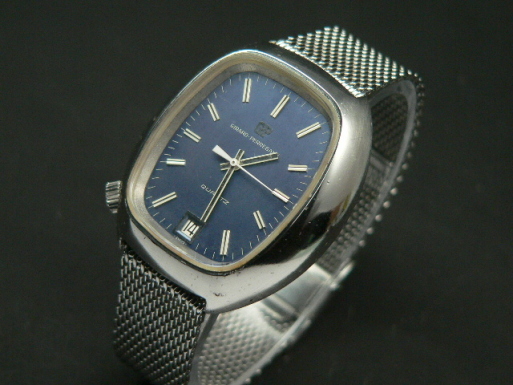
Girard-Perregaux and The Quartz Scare


This newspaper advertisement from the Winnipeg Free Press, November 27th, 1972 and others like it almost brought the world of mechanical watch making to its knees. A Watch only less accurate than the sun itself is quite a statement. While reading this 40 year old article, I can sense the shudder that pervaded the Mechanical Watch World in the early 1970's when Quartz watches flooded the market, relatively cheaper and more accurate than their mechanical counterparts.

Girard-Perregaux Calibre 351 (1970's)
This thought was very much the same of many companies that became redundant due to modern technologies. Companies that made camera film for camera's, ribbons for typewriters, VHS , gas lanterns and carriages for horses.
The Mechanical Watch World thought their days were numbered, and truth be told the sales of Mechanical Watches plummeted. Less people learned the trade of Mechanical Watch Making as they saw no future in it. Companies like Blancpain became dormant shutting their doors and vowing emphatically never to produce a watch powered by quartz (To this day they still have not).
Other companies like Girard-Perregaux were not as gloomy, but on the contrary grabbed the Quartz Revolution by the horns, revamping its Research Development Department and becoming a major player in the Quartz Revolution.  In the early 1970's, the Girard-Perregaux Calibre 351, unveiled in 1969, was  mass produced and widely available.  It was relatively expensive, but the novelty of a watch, which required no winding and was only less accurate then the sun itself, boosted sales.
Girard-Perregaux Laureato (2010)
Today  Girard-Perreagux holds much pride in its Quartz Accomplishment. In January 2010,  the Girard-Perreaguax Laurateo (cost - $11,500) housing a GP 13500 quartz movement commemorated its 40 years in the quartz industry and the successful establishment of the quartz crystal's frequency of 32.768 hertz - a specification standard to all quartz calibers  today.
In fact Girard-Perregaux holds its quartz accomplishments in as great esteem as its iconic three gold bridges movement crafted over 100 years prior.  This year at the SIHH 2012, Girard-Perregaux joined these iconic milestones, separated by over 100 years, into a symbolic timepiece - the Girard-Perregaux Laureato Tourbillon with 3 spinal blue bridges.  The Original Girard- Perregaux Triple Gold Bridges was patented in March 1884, but developed in the 1860's.
Girard-Perregaux Tourbillon 3 Bridges (2012)
 The newest Laureauto Tourbillon is limited to 10 pieces and houses a automatic mechanical Girard-Perregaux 9600-0004 movement, within a 42.6 mm titanium case.  An octagonal platinum bezel add  bright bands of luster achieved by alternating  brushed and polished finishes accentuating the translucent blue of the clear spinal bridges. Spinals , a precious gem from the Corundum family, is the perfect material to use since the gem  requires very little treatment as  in nature they are flawless and transparent.   The clarity of the stone is a blue hued window to a tourbillon suspended beneath the bridge above the 6'o'clock position as well as mechanical components beneath the other bridges.  The transparent case back reveals the excellent mechanics in motion.  A rugged titanium bracelet fastened the timepiece securely to ones wrist.

So it seems that as a result of the inexpensiveness, accuracy, and sheer numbers of Quartz Watches available, Mechanical Watches would vanish from the modern world. It seemed The Mechanical Watch World was on the brink of extinction ,when the novelty of the Quartz watches began to fade, and slowly Mechanical Watches made a come back. Mechanical Watches now filled a different role of times past. Mechanical Watches filled the role of class, quality and centuries old tradition. True they are less effected by adverse temperatures, and can last longer if maintained , but it is not a competition between the two that can be tabulated. The two types of watches are very different, and it is in their difference that each will attain their place in the Watch World. Gerard-Perregaux found a place for Mechanical and Quartz Watches to exist in a harmonious balance. Excepting both and detracting from none. 

Senin, 13 Februari 2012

The Man Who Started the Wristwatch Trend

Albert Santos-Dumont had the vision to fly, and was one of the early pioneers of flying. He was a celebrity of his time, flying amidst the wondrous upturned faces of the public. They wanted to be like him to dress like him, he was their icon, their superstar, and anything he wore was replicated by thousands... and so the wristwatch became popular.

Santos-Dumont was born on July 20th, 1873, in the Brazilian town of Palmira, the sixth of eight children. His father was French, an engineer and he owned a coffee plantation in the state of Sao Paulo. His father was known as the " Coffee King of Brazil" as he made a large fortune utilizing latest labor saving inventions of that time.

Santos-Dumont ,as a young child, looked up into the brilliant expansive view of the Brazilian sky and dreamed of flying. His father sustained an injury by falling from a horse and moved the family to Europe. Santos-Dumont who had always been fascinated with machinery bought himself an automobile and later studied physics. chemistry, mechanics and electricity.
Still his dream of flying persisted and he hired an experienced balloon pilot to take him on as a passenger, then he piloted the balloons himself, and then flew dirigible balloons (many people are more familiar with the German Zeppelin like that which docked atop the Empire State Building).
Santos-Dumont built and flew 11 dirigibles from 1898 and 1905. He would cruise along Paris boulevards at rooftop level, landing outside outdoor cafes for lunch.

He won the Deutsch de la Meurthe Prize by flying his "lighter than air"aircraft from Parc Saint Cloud to the Eiffel Tower in less than thirty minutes, but it was the "heavier than air aircraft" that gained most of his attention. He flew an airplane he built, the 14-bis, on October 23, 1906, in front of a crowd of rapt spectators, 200 feet at a height of 10 feet above the ground. He was awarded the Archedeacon Prize in July 1906 as he was first aviator to fly more than 25 meters.

In 1904 while Santos-Dumont was celebrating his win of the Deutsch Price at the Maxim's Restaurant in Paris, he complained to his old friend ,Louis Cartier, about the difficulty of checking his pocket watch while trying to handle the controls of his aircraft. Santos-Dumont asked Louis Cartier to come up with a different way of checking the time whilst keeping both hands on the control. Louis Cartier and his master watchmaker ,Edmond Jaeger, brainstormed, and soon came up with the first prototype for a man's wristwatch. It was a watch on a leather strap with a buckle to be tied around the wrist. This was not the first time a wristwatch was invented, Patek Phillipe had created a wristwatch in 1868 for the Countess Koscowicz of Hungary, but Patek Phillipe creation was more of a style statement than the need for practicality.

After Santos-Dumont was presented with his wristwatch, he never flew without it, and it was with the Cartier wristwatch that Santos-Dumont, on November 12, 1906, used to confirm that he had broken his own personal record for flying 730 ft in twenty one seconds.

Santos-Dumont was nicknamed "le petit Santos" and the stylish of that time copied Santos-Dumont wardrobe from his high collared shirts to his singed Panama hat to his Cartier man's wristwatch. Santos-Dumont was indeed a trend setter, men are still very much wrist watch wearers; although they have done away with their high collared shirts and singed Panama hats.


To honor Santos Dumont, Cartier has an entire Collection of wristwatches called Santos de Cartier. This collection includes Santos 100, Santos Dumont, and Santos Demoiselle for ladies. The striking square case provides a sense of complete equilibrium as well as practicality.

Jumat, 13 Januari 2012

The Origins of The Eterna Logo

One can never mistake an Eterna Watch. On the dial are five dots below the 12 'o'clock. But what are the dots? Do they mean something? Why did Eterna choose a seemingly random dot pattern?
Eterna's logo hints at a certain technological improvement to a certain watch movement. Read more and you will find out.

In 1856 Eterna began strictly as a company manufacturing blank movements. Not unlike hundreds of such watchmaking workshops dotted around Switzerland. In time Eterna's supreme quality of work became widely recognized. Urs Schild, who co-founded the company with Dr Josef Girard, had a vision of producing a watch from start to finish . Thecompany bore the name of Schild Fréres, and manufactured small ladies wrist watches adapted from pocket watches. In 1905 the company changed its name to Eterna. By 1925, Eterna watches were
being advertised in US newspapers such as the Southtown Economist 12/01/1925. By then Eterna had made history. In 1914, at the Swiss National Exhibition in Bern, Eterna intro
duced the first alarm wristwatch - 6 years after Eterna had patented it. Eterna watches were coveted for their slimness and precision. In 1930, Eterna unveiled the smallest Baguette Calibre
Watch, which was manufactured in series production. Still no logo marked the dial. However in 1948 Eterna's dial would change forever. The logo marks a huge technological milestone unveiled in 1948. Eterna introduced the Eterna-Matic which comprised of a low friction ball bearing used to support the rotor of the automatic movement. This led to a great increase in the efficiency of the rotor. The invention of the Eterna-Matic with its ball bearings had such an overwhelming effect on Eterna, it fashioned its logo after five ball bearings.

The five ball bearings grace every dial of an Eterna timepiece.

Jumat, 11 November 2011

The Effect of War on Watches

The demands of War has shaped the Watch Industry in countless ways. In the early, 1700's, tracking the inevitable passage of time was a matter of life and death. The intense need for an accurate timepiece was magnified on October 22, 1707, when four British Men 'O War sank just off the Cornish Coast and 2000 men were lost. This was not as a result of enemy fire, but rather human error. The fleet had no idea where they were, as they had no precise chronometer to decipher how far off the Longitude they were. The British Parliament , aggravated by this obviously needless catastrophe, passed the Longitude Act of 1714 whereby: A huge sum of money would be awarded to anyone who could invent a way to determine the precise longitude of a ship's location to within less than one degree. Click here learn more about the Longitude Act of 1714. John Harrison's marine chronometer was the first timepiece to successfully determine longitude at sea and in 1773, after much controversy, he was awarded his prize.
A pocket watch belonging to Abraham Lincoln recently turned up a couple years back with an ancient engraving referencing the American Civil War.
In 1880, German Emperor Wilhelm I visited the Berlin Trade Fair and spotted some prototype wristwatches designed by Constant Girard , he ordered 1000 for the German Imperial Navy wristwatches, and by 1880, 2000 had been produced and delivered. The cage protected the watch face in battle. Although, wristwatches were more handy than the popular pocket watches, they still did not hit the general market until Santos-Dumont ,a Brazilian aviator and popular icon, began wearing one. He approached Louis Cartier to fashion a watch so that he could keep both hands on the aircraft controls during flight. Being the trendsetter of the early 1900's, he popularized the wrist watch. Click here to learn more about Santos-Dumont

During World War I, in the dark trenches, soldiers were not able to see their time pieces, and so luminescence was applied to the dial. Unfortunately, the luminescence used was comprised of highly radioactive Radium. While the lume was highly effective in reading the numbers of the dial in the dark, the young girls who had painted the lume on the dials, died from the results of the exposure.
Click here to read their story - The Deadly Dials and Glowing Girls

Many Watches were designed with protective grills such as the
WWI British Air Force Military Watch depicted here.
Watches on today's market, are fashioned after military vehicles. The Cartier Tank was created by Louis Cartier in 1917, and inspired by the new Renault tanks which Cartier saw in use on the Western Front. The first Cartier Tank was presented to General John Pershing of the American Expeditionary Force. The lines and proportions are similar to those of tanks found on First World War battlefields. The bracelet represents the Tanks treads.
An entire company "U-Boat" is named after the German submarines from World War I and World War II. U-Boat is short for the German word "Unterseeboot" which literally means "undersea" boat.

Bell and Ross fashion its watches after the dials on a military aircraft. On March 18th, 2009, Bell and Ross became the official supplier to the French Air Force. The French Air Force requested that Bell and Ross create a watch specifically designed to meet the timepiece requirements of fighter pilots - the BR 03 Type Aviation. In addition, in Basel World, Bell & Ross unveiled the Limited Edition BR 01 Airborne which bares the skull motif on the watches dial. The motif originated in World War II and is accompanied by US Airborne motto, "Death from Above". A reminder of the courageous military paratroopers who jumped into enemy territory. The skull symbolized their incredible bravery . The skull motif was used by the military on fighter jets and patches. It was a symbol of strength and defiance of defeat even in the face of death. Today the skull is a tribute to all those brave men and women in combat who serve to defend this country. On March 18th, 2009, Bell and Ross became the official supplier to the French Air Force.

Many other brand Name Watch companies have become official suppliers for Army's. Breitling is the official supplier to the Royal Air Force, where the impeccable craftsmanship and exceptional endurance was tested in extreme atmospheric conditions.
Ebel supplied the British Royal Air Force with watches from 1939-1945.
Elgin (former watch company) issued this Canteen Watch to the U.S Navy during world war two. The crown flips off like the top of a canteen. (see inset)
In 1938, Longines crafted “Anti-magnetique” for the Czech Air Force.


Bremont, a British Luxury Watch Brand has taken history to a new dimension. Its EP120 pilot’s watch, depicted on the right, is made with parts from the famous RAF 1942 Spitfire Mk V fighter plane which shot down six enemy planes in a single day in World War II. Original parts of this plane has been featured in films such as the Battle of Britain. Pieces that were salvaged during the planes restoration have been incorporated into the EP120’s dial and movement.

In war, tracking time is a matter of life and death.

Today is Veterans Day. We salute all those who have put their lives on the line, and fought for this country.

Selasa, 11 Oktober 2011

Cuervo y Sobrinos since Havana 1882

Men's Esplendidos Dual Time
A timepiece born from the workbenches of Cuervo y Sobrinos evoke a sense of Caribbean languorousness marked by deep blue skies, caressing ocean breezes and the slowed passage of time with a hint of exotic excitement. The timepiece carries the mark of its birthplace: The Havana of 1882.

Havana of 1882 was a place of extreme culture where scholars,navigators, explorers, tourists flocked to soak up the Caribbean sun and the rich culture.  Of course with a long list of aristocratic clientele and people of discretion disembarking on the shores of Havana, the citizens of Havana made sure to provide luxurious accommodations, excellent service, mouthwatering cuisine and  products crafted, to utter perfection, imbued with the spirit of Havana.

Havana 1882
It was in this rich bustling arena, Amando Rio y Cuervo and his brothers poured much energy into  their Uncle Ramon's watchmaking business - hence the current name of the company " Cuervo y Sobrinos" - "Cuervo and Nephews". The store was located on Havana's Fifth Avenue where discerning visitors purchased fashionable timepieces and other beautiful things. The clocks and watches they produced were of exceptional craftsmanship,  mechanical movement mastery, design and functionality.  Over the years, their fame spread, and the desire for watches and clocks produced by La Casa (the house) grew.  This prompted Cuervo y Sobrinos to open more locations in Pforzheim, Baden, Germany; on the rue Mezley in Paris and at the centre of the watchmaking world- La Chaux-de-Fonds. By the end of the 19th century, Cuervo y Sobrino's timepieces were dubbed "Pearl of Carribean". By the 1940's Cuervo y Sobrino's was known as one of the most prestigious brands in the world of Horology.  Their fame spread and soon famous people were visiting "La Casa' to purchase exceptional classic timepieces of their own.  Noted individuals such as Einstein, Churchill, Hemmingway, Gable are just some of the names in Cuervo y Sobrinos historical record - its 'golden book" who visited "La Casa".

Now you can have the opportunity of owning a Cuervo y Sobrinos Elegant Timepiece at THE WATCHERY. A distinguished taste in watches.


Senin, 21 Februari 2011

Gevril -"Watchmaker to the Crown"

The year is 1758, the world is embroiled in the Seven Years' War and George Washington is a young senior officer of the colonial forces. It will be another 31 years before he becomes the first president of the United States. 1758 is also the year the watch company, Gevril - watchmaker of kings, is founded in the Swiss La Chaux-de-fonds.

Like his elder master watchmaker, Daniel JeanRichard, Jacques Gevril began restoring timepieces. His talent and superior craftsmanship were immediately recognized. This is in an era where precision timekeeping is at a frenzy, fueled in part by the Longitude Act of 1714.

In 1743, Jacques Gevril crafted his own chronometer enabling sea vessels to determine their longitude and preventing terrible accidents at sea. The legend of Jacques Gevril's unparalleled watchmaking abilities travelled far and wide. In 1758, the king of Spain, Ferdinand VI, known for his refined tastes, heard about a legendary watchmaker, Jacques Gevril, and send a messenger to commission a timepiece for His Majesty. On completion, Jacques Gevril voyaged to Madrid to personally present his timepiece to the King.

At first glance, the King realized the timepiece was nothing like he had ever seen before. Used to a life of luxury, he had seen many beautiful things in his days, but this timepiece was different. The King was so impressed by the impeccable craftsmanship and sought after precision, he appointed Gevril "Watchmaker to the Crown."


Gevril watches became renowned for their high quality, and thus gained international success. Jacques's talented son, Moyse Gevril followed in his father's footsteps, and ,in 1784, he too found success as "Master Clockmaker" In the 1800's, Gevril's enamelled dials became all the rage, while constantly improving precision.

(inset circa 1781)

Gevril watches were highly known among horological circles, but lesser known among the general public and knowledge of these fine watches dwindled. In 2001, the brand name was given a breath of new life.


The brand name was purchased by Mr. Samuel Friedman, an American salesman, who understood the importance of upholding Gevril's 250 years of watchmaking tradition as well as catering to the current horological arena. Mr. Friedman even goes as far as fashioning his dials in the likeness of the dials from the Gevril of yesteryear. Gevril watches are meticulously hand crafted utilizing high quality materials.

A highly popular model is the Glamour Pink Dial Leather Women's as well as The Avenue of America's Timepiece depicted to the left sporting a sleek elegant rectangular dial surrounded by a warm 18k rose gold bezel rendering a bold presence. Arabic Numeral hour markers seem to dance and glitter with confident energy. The impeccable craftsmanship is evident in the sleek design and precise timekeeping. With this type of quality, it is no wonder that Gevril manufactured a mere 6000 pieces a year. Collections are created in limited editions of but 250 pieces for steel versions and 100 pieces for gold versions. Gevril is not looking to provide watches to the masses, but rather to people who appreciate the art of excellent watch making.

Jumat, 03 Oktober 2008

The Legend of Daniel Jean Richard

Jean Richard is a Luxury Watch Company baring the name of a legend. Daniel JeanRichard. He was born in 1665 in an emerald green valley of La Sagne in a place called "Les Bressels" (a product line Bressel is dedicated to his birth place).

In 1679 a horse dealer rode through town with a pocket watch which had ceased to work. He spotted a young boy of about 15 who was working on some filigreed iron wares. He stopped and watched the boy for a minute, intrigued by the boy's obvious talent. The man fingered his valuable pocket watch, thinking. He got off his horse and came towards Daniel JeanRichard. Their was something about the boy that made the man trust him, and he pulled his English pocket watch out of his baggage.

The boy stretched out his hand and the man placed the watch in the boy's eager hand. The boy had never before laid eyes on a watch. He slowly opened it mesmerized. In that instant as he held the watch, his fate was sealed and a legend was born.

"Can you repair this watch," the man asked.

The boy captivated by the watch did not answer. The man repeated his question and the boy nodded.
"I will return in a few weeks on my way back from Geneva. Do you think you can repair it by then?"
The boy who had never beheld a watch before replied, "Yes sir, I can."

Daniel JeanRichard gently placed the English pocket watch on his work bench. He had no tools to repair the watch, but he was not deterred. He studied the watch with intense concentration, memorizing every detail. He made a set of primitive tools and he repaired the watch.
While the winter snow piled high against the wall of the blacksmith's shop, Daniel JeanRichard built ,from memory, an exact replica of the English pocket watch, the first watch ever to be made in this region. Up until this day no one had achieved this remarkable feat of building a watch from memory.

Documentation is scant in terms of the exact details of the legend, and their are some conflicting reports in regard to Daniel JeanRichard's age at the time he held his first watch.

Until his death in 1741, Daniel JeanRichard invented machines and tools essential for watchmaking, as well as the basic principles of the apprenticeship of the watchmaking trade.